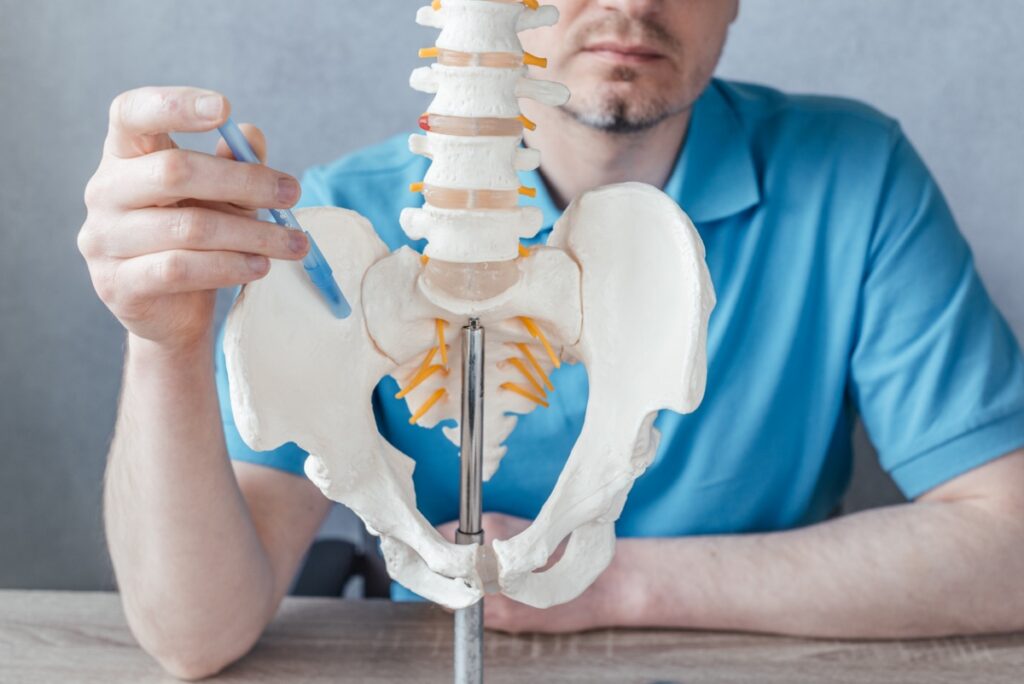
Sacroiliac joint pain is a common but often misunderstood cause of low back, butt, hip, or upper leg discomfort. The sacroiliac joints sit where the lower spine meets the pelvis, helping transfer weight between the upper body and legs. When one or both joints become irritated, inflamed, unstable, or mechanically stressed, pain may worsen with standing, walking, climbing stairs, turning in bed, or getting up from a seated position. Because sacroiliac joint pain can resemble lumbar disc disease, hip arthritis, or sciatica, accurate diagnosis is an important first step before treatment begins.
Initial treatment usually focuses on conservative care. Activity modification may help reduce irritation without fully limiting movement. Physical therapy often plays a central role, especially when muscle imbalance, poor pelvic control, stiffness, or altered gait contributes to symptoms. Therapy may include core and hip strengthening, stretching, manual techniques, posture training, and education on safer movement patterns. Some patients benefit from a sacroiliac belt, which provides external support around the pelvis and may reduce painful motion across the joint. Anti-inflammatory medications, when medically appropriate, may also help control pain during flare-ups.
When conservative treatment for sacroiliac joint pain does not provide enough relief, image-guided injections may be considered. A sacroiliac joint injection typically places a corticosteroid and local anesthetic into or around the joint under fluoroscopy or other imaging guidance. These injections can serve two purposes. First, temporary pain relief after the local anesthetic can help confirm that the sacroiliac joint is a major pain source. Second, the steroid may reduce inflammation and provide longer-lasting improvement. The duration of benefit varies from patient to patient, and injections are often used as part of a broader rehabilitation plan rather than as a stand-alone cure.
For chronic sacroiliac joint pain that appears to come from the nerves supplying the back of the joint, radiofrequency ablation may be an option. This procedure uses heat generated by radiofrequency energy to disrupt pain signals from targeted sensory nerves, commonly including lateral branches from the sacral nerves and sometimes the L5 dorsal ramus. Radiofrequency ablation does not remove the joint or correct structural problems, but it may reduce pain enough to improve function and participation in therapy. Relief can last months or longer, although nerves may regenerate over time and symptoms can return.
In selected patients with severe, persistent sacroiliac joint pain that has not responded to less invasive treatments, sacroiliac joint fusion may be discussed. Fusion is a surgical procedure designed to stabilize the joint by encouraging bone growth across it, often with implants. It may be considered when pain is strongly linked to sacroiliac joint instability or degeneration and when diagnostic steps support the joint as the pain generator. Because surgery involves recovery time and carries risks, it is usually reserved for carefully evaluated cases.
Research and innovation continue to expand the treatment landscape for sacroiliac joint pain. A recent preliminary study evaluated focused ultrasound as a noninvasive way to create targeted thermal lesions near the sacroiliac joint nerves. The study used cadaveric testing and computer simulation to assess whether focused ultrasound could heat treatment targets while avoiding critical structures inside the sacral foramina, where nerve roots pass. The authors reported that their models supported initial safety and feasibility, producing lesions in simulated treatments without indicating ablation of the intraforaminal nerve roots. However, this remains early-stage research, and the authors noted limitations including small sample size, modeling assumptions, and the need for further animal or clinical studies before broad conclusions can be made.
The best treatment modalities for sacroiliac joint pain depends on the cause of the pain, symptom duration, physical examination findings, imaging when appropriate, and response to diagnostic injections. Many patients improve with a stepwise plan that begins conservatively and advances only when needed. A spine and joint specialist can help determine whether the pain truly comes from the sacroiliac joint and which treatment options offer the most appropriate balance of safety, recovery, and expected benefit.