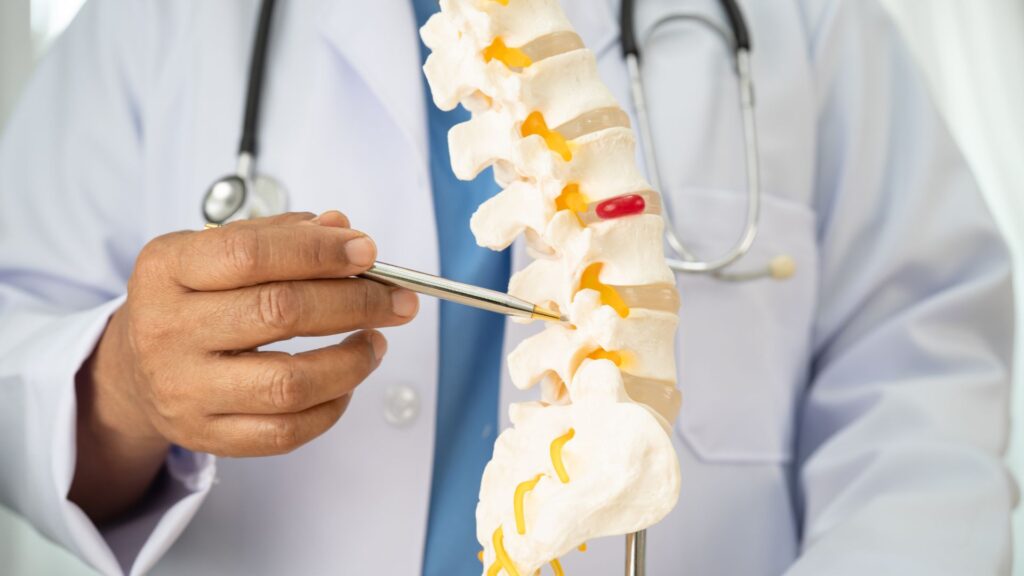
Degenerative disc disease occurs when one or more spinal discs break down over time. Spinal discs sit between the bones of the spine (vertebrae) and act as cushions that absorb shock and allow the spine to move.
Each disc has a soft inner center called the nucleus pulposus and a strong outer ring called the annulus fibrosus. As discs age, they can lose water, become thinner, and develop small tears. These changes reduce the disc’s ability to cushion the spine and may lead to pain.
Degenerative disc disease most commonly affects the lower back (lumbar spine) or neck (cervical spine).
Symptoms
Some people with degenerative disc disease have no symptoms. When symptoms occur, they often include:
Lower back pain or neck pain
Pain that may spread to the buttocks or thighs
Pain that comes and goes over time
Pain that worsens with sitting
Pain that worsens with bending, lifting, or twisting
Pain that improves with walking or changing positions
Pain that improves when lying down
In some cases, disc degeneration may irritate nearby nerves and cause numbness, tingling, or weakness.
Degenerative disc disease is usually caused by natural aging and wear on the spine.
Common causes include:
Age-related disc degeneration
Repetitive strain on the spine
Spine injuries or trauma
Loss of disc hydration and elasticity over time
These changes can cause discs to weaken, thin, or collapse.
Diagnosis
Diagnosis usually begins with a medical history and physical examination. A doctor will evaluate pain, mobility, reflexes, and muscle strength.
Imaging tests may be used to confirm the diagnosis, including:
X-rays to show narrowing between vertebrae or bone spurs
MRI scans to detect disc damage, herniation, or nerve compression
CT scans to examine the bones of the spine and nerve pathways
These tests help identify the location and severity of disc degeneration.
Treatment Options
Conservative (Non-Surgical) Treatment
Treatment typically starts with non-surgical care. Many patients improve with conservative treatment.
Common treatment options include:
Pain medications or anti-inflammatory drugs
Physical therapy and strengthening exercises
Rest and activity modification
Chiropractic care
Interventional Pain Management
If pain continues, interventional pain management procedures may be recommended, including:
Epidural steroid injections
Trigger point injections
Facet joint injections
Intradiscal injections
Radiofrequency ablation
Intradiscal electrothermal therapy
Nucleoplasty
Surgery may be considered when other treatments fail to relieve symptoms or when severe nerve compression occurs.
When to Seek Evaluation
Persistent lower back pain, neck pain, or radiating nerve pain should not be ignored. Early evaluation allows for proper diagnosis and targeted treatment, helping prevent progression and long-term complications.