
A trigeminal nerve block is a minimally invasive, image-guided procedure used to treat chronic facial pain caused by trigeminal neuralgia, shingles, and other facial pain syndromes. The injection delivers local anesthetic and corticosteroid medication near the trigeminal nerve to interrupt pain signals and reduce inflammation.
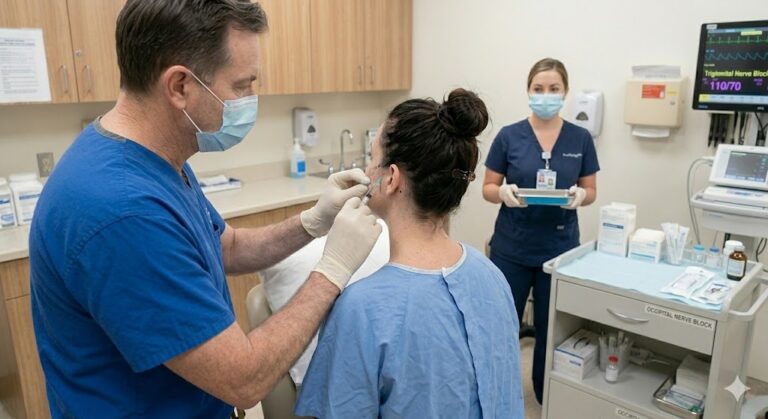
Trigeminal nerve blocks are commonly recommended for patients with severe, persistent facial pain that has not responded to oral medications.
A trigeminal nerve block involves injecting a local anesthetic, often combined with a corticosteroid, near one of the trigeminal nerve branches.
The injection works by:
Pain relief may occur immediately due to the anesthetic. Longer-term relief typically develops within two to three days as the steroid reduces inflammation.
Trigeminal nerve blocks are indicated for:
These injections are especially beneficial for patients with sharp, shooting facial pain that interferes with daily function.
Patients may experience:
These symptoms are characteristic of trigeminal neuralgia and related neuropathic conditions.
Trigeminal nerve blocks are performed in an outpatient setting under imaging guidance.
The procedure includes:
A series of injections may be recommended to improve the duration and effectiveness of pain relief.
The injection delivers local anesthetic and corticosteroid near the trigeminal nerve to block pain signals and reduce nerve inflammation.
The procedure typically takes 15 to 30 minutes and is performed in an outpatient setting under imaging guidance.
Temporary relief may occur immediately from the anesthetic. Longer-lasting relief usually begins within two to three days as the steroid takes effect.
Relief can last weeks to months, depending on the severity of trigeminal neuralgia or facial nerve inflammation.
Trigeminal Nerve Block is available at our Jersey City, NJ office at 100 Town Square Place, Suite 405. Serving patients from Hoboken, Bayonne, Weehawken, and surrounding Hudson County communities. Learn more about pain management in Jersey City.
Reach out to our specialists to schedule an initial consultation. We’ll carefully review your symptoms and match you with the right expert for your specific condition.