Discography, also known as a discogram, is a minimally invasive diagnostic procedure used to determine whether a spinal disc is the source of chronic back pain or neck pain. It is typically performed when MRI, CT scans, and other noninvasive imaging studies fail to clearly identify the pain generator.
Discography helps isolate discogenic pain by directly testing the suspected intervertebral disc under controlled conditions.
Discography is an image-guided diagnostic procedure in which contrast dye is injected into the center of an intervertebral disc. The discs are sponge-like cushions located between the vertebrae that absorb shock and allow spinal flexibility.
When a disc becomes degenerated, torn, or ruptured, it may:
A discogram helps determine whether a specific disc is responsible for a patient’s persistent pain.
Discography may be used to evaluate:
It is particularly useful when multiple discs appear abnormal on MRI and the exact pain generator is unclear.
A discogram is generally considered only after:
Discography is often used before spinal fusion or other surgical interventions to ensure accurate targeting of the painful disc.
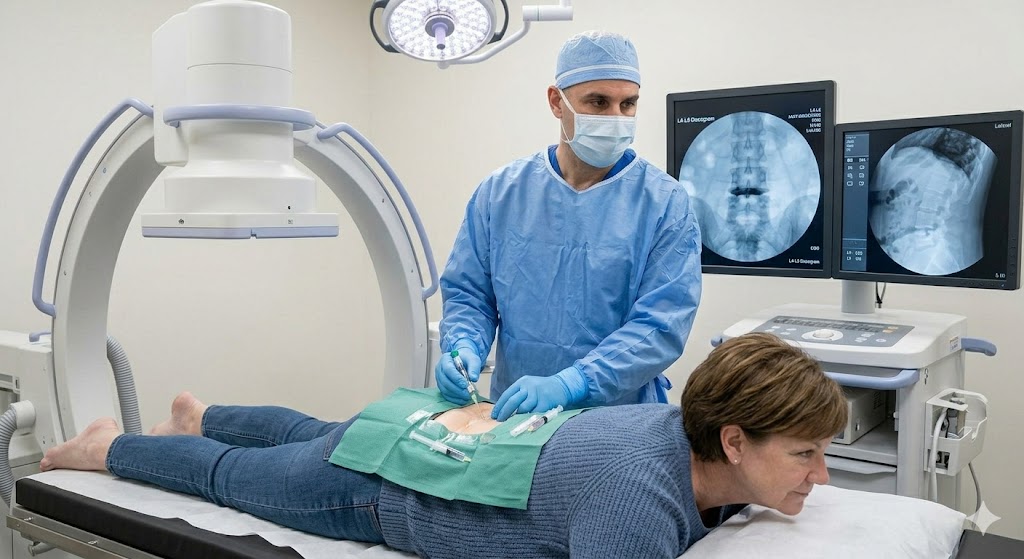
Discography works by increasing pressure within the disc. In an abnormal or degenerative disc, this may trigger pain due to:
A normal disc typically does not reproduce significant pain when injected.
A discogram is a diagnostic procedure used to determine whether a specific spinal disc is the source of chronic back or neck pain.
During the procedure, contrast dye is injected into a spinal disc under imaging guidance. If the injection reproduces the patient’s typical pain, the disc may be identified as the pain source.
Discography is typically recommended when MRI or CT scans cannot clearly identify the cause of persistent back pain.
Some discomfort may occur during the injection because the goal is to reproduce the patient’s typical pain. Local anesthesia is used to minimize discomfort.
Discography (Discogram) is available at our Jersey City, NJ office at 100 Town Square Place, Suite 405. Serving patients from Hoboken, Bayonne, Weehawken, and surrounding Hudson County communities. Learn more about pain management in Jersey City.
Reach out to our specialists to schedule an initial consultation. We’ll carefully review your symptoms and match you with the right expert for your specific condition.
CLINIC LOCATION
100 Town Square Place, Suite 405
Jersey City, NJ 07310
DIRECT CONTACT
(908) 665-1938
infor@urbanspinejoint.com