Disclaimer: This article is intended solely for informational and educational purposes only. It does not constitute medical advice.
Chronic low back pain can be difficult to treat because it often involves more than one structure, including joints, discs, muscles, ligaments, and the nerves that carry pain signals from the spine to the brain. For some patients, pain continues despite physical therapy, medications, injections, or radiofrequency ablation. Peripheral nerve stimulation for chronic low back pain, often called PNS, is an emerging treatment option that has not responded to more conservative care which designed to interrupt pain signaling without permanently altering the spine or destroying nerve tissue.
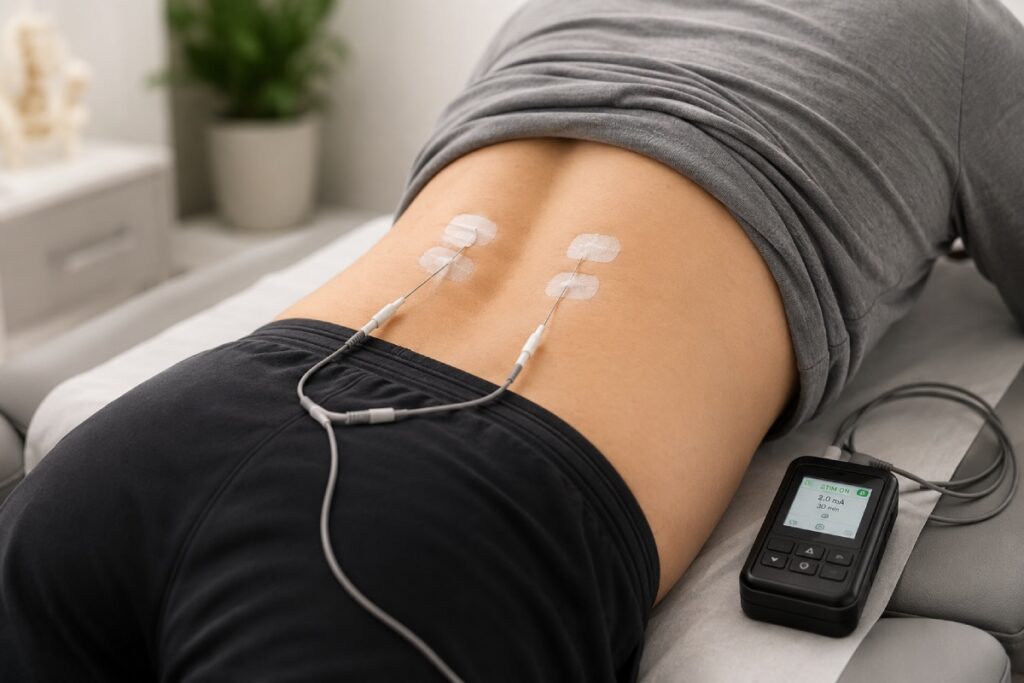
Peripheral nerve stimulation uses small electrical impulses to influence nerves involved in pain transmission. For chronic low back pain, one commonly studied target is the lumbar medial branch nerves, which are small nerves that help carry sensation from the facet joints and also communicate with the deep stabilizing muscles of the spine. During the procedure, thin leads are placed through the skin near the target nerves using image guidance such as ultrasound or fluoroscopy. These leads are connected to an external stimulator that delivers mild electrical pulses. Patients usually feel a tingling or pulsing sensation over the painful area rather than sharp stimulation.
Unlike spinal cord stimulation, which typically involves a more permanent implanted system, some forms of PNS are temporary. A 60-day course of treatment, for example, places temporary leads near the nerves for about two months and then removes them. The goal is not simply to cover up pain while the device is active, but to help “reset” or recondition pain pathways. Chronic pain can make the nervous system overly sensitive, causing pain signals to persist even after the original injury has healed or stabilized. By repeatedly stimulating selected peripheral nerves, PNS may help calm abnormal pain processing and improve function after treatment ends.
Patients who may be considered for peripheral nerve stimulation generally have chronic low back pain that has lasted for months and has not improved enough with conservative care. A spine and joint specialist will usually begin with a careful history, physical examination, and review of imaging when appropriate. PNS may be discussed when pain is mainly axial, meaning centered in the low back rather than dominated by pain traveling down the leg. It is not suitable when symptoms are caused by severe spinal stenosis, active infection, unstable spinal conditions, untreated major nerve compression, or other problems that require a different treatment approach.
The procedure is minimally invasive, but it is still a medical intervention. Potential risks include soreness, bleeding, infection, skin irritation from adhesive dressings, lead movement, or incomplete pain relief. Patients must also be willing to follow instructions during the treatment period, including wearing the external stimulator and using it for the prescribed number of hours per day. Proper placement of the leads and consistent use of the device are important because the stimulation needs to cover the painful region comfortably and reliably.
Emerging research has focused on which patients are most likely to benefit and how treatment should be delivered. The RESET clinical trial examined 60-day percutaneous peripheral nerve stimulation of the lumbar medial branches for chronic low back pain. The study found that patients who received treatment according to protocol, defined as bilateral stimulation covering most of the painful low back region for 6 to 12 hours per day, had higher odds of meaningful pain relief.
In the per-protocol group, 63% reported at least 50% pain relief at three months after treatment, with similar positive findings in exploratory groups with facetogenic and discovertebral pain features. Improvements in pain interference and disability were also sustained through six months, although longer follow-up is still ongoing. The authors emphasized that good lead placement, patient education, and adherence may be key factors in outcomes.
Peripheral nerve stimulation is not a cure for every case of chronic low back pain, and it should be considered as part of a broad set of potential treatment strategies. For some patients, it may offer a less destructive alternative to nerve ablation and a less invasive option than permanent implantable neuromodulation. A thoughtful evaluation by a spine and joint specialist can help determine whether PNS fits the patient’s diagnosis, goals, activity level, and prior treatment history.