An occipital nerve block is a minimally invasive injection used to treat migraines, chronic headaches, and occipital neuralgia. The procedure targets the greater occipital nerve, which provides sensation to the back and top of the head.
When the greater occipital nerve becomes irritated or inflamed, it can cause severe head pain that begins at the base of the skull and radiates toward the temple, forehead, or behind the eyes.
An occipital nerve block involves injecting a local anesthetic, with or without corticosteroid medication, near the greater occipital nerve where it crosses the base of the skull.
The injection works by:
Occipital nerve blocks are commonly used for patients with migraine headaches and nerve-related head pain.
Occipital nerve blocks are effective for:
These injections can significantly reduce headache severity and frequency.
Patients with occipital nerve irritation may experience:
Occipital neuralgia often mimics migraine but is caused by nerve irritation rather than vascular changes.
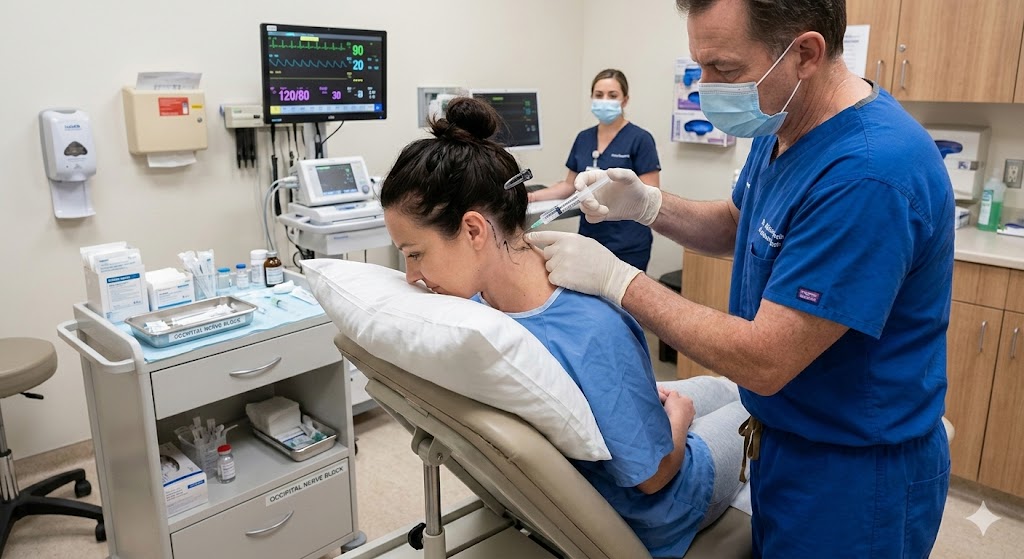
Occipital nerve blocks are performed in an outpatient setting and typically take only a few minutes.
The procedure includes:
Patients often experience immediate relief from the anesthetic. The steroid component may provide longer-lasting relief within two to three days, with benefits lasting several weeks to months.
In some patients, repeat injections may be recommended depending on symptom recurrence.
The injection delivers corticosteroid medication into the epidural space to reduce inflammation around irritated thoracic nerve roots, helping relieve back pain and radiating chest or rib pain.
The procedure typically takes 15 to 30 minutes and is performed in an outpatient setting under fluoroscopic (X-ray) guidance.
Some patients experience temporary relief the same day from the anesthetic. Steroid-related relief usually begins within a few days.
Pain relief may last several weeks to several months, depending on the severity of the thoracic disc herniation or spinal stenosis.
Occipital Nerve Block is available at our Jersey City, NJ office at 100 Town Square Place, Suite 405. Serving patients from Hoboken, Bayonne, Weehawken, and surrounding Hudson County communities. Learn more about pain management in Jersey City.
Reach out to our specialists to schedule an initial consultation. We’ll carefully review your symptoms and match you with the right expert for your specific condition.
CLINIC LOCATION
100 Town Square Place, Suite 405
Jersey City, NJ 07310
DIRECT CONTACT
(908) 665-1938
infor@urbanspinejoint.com