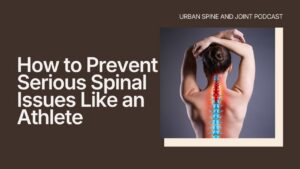
For many patients living with chronic lower back pain, surgery feels like the only remaining option. But new regenerative and minimally invasive treatments are changing that conversation. In this episode, Urban Spine and Joint explores how combining pulsed radiofrequency (PRF) therapy with platelet-rich plasma (PRP) may help relieve pain and support tissue healing without spinal surgery.
Podcast Overview
This episode focuses on lumbosacral spondylolisthesis, a condition where one vertebra slips over another, often compressing nearby nerves and causing severe lower back pain, sciatica, and stiffness.
The discussion explains how pulsed radiofrequency therapy works by disrupting pain signals without permanently damaging nerves, while platelet-rich plasma therapy supports healing by stimulating tissue repair and collagen production.
Listeners also learn why the combination of PRF and PRP has become an increasingly promising option for patients seeking alternatives to spinal surgery.
Timestamp Breakdown
00:00 – Introducing a Non-Surgical Back Pain Treatment
The episode opens by introducing a combined treatment strategy using pulsed radiofrequency (PRF) and platelet-rich plasma (PRP) for chronic lower back pain.
00:21 – Understanding Lumbosacral Spondylolisthesis
The hosts explain how vertebral slippage at the base of the spine compresses nerves, leading to symptoms like sciatica, stiffness, and chronic pain.
00:51 – Why Traditional Radiofrequency Treatments Can Be Aggressive
The discussion compares traditional continuous radiofrequency ablation, which destroys nerves with heat, to the more controlled approach used in pulsed radiofrequency therapy.
01:19 – How PRF Changes Pain Signaling
Listeners learn how PRF uses electromagnetic pulses to alter the environment around pain-transmitting nerves, reducing pain without permanently damaging the nerve itself.
01:47 – Why Controlled Inflammation Can Be Helpful
The episode explains the difference between harmful chronic inflammation and carefully targeted microscopic inflammation that helps regulate nerve signaling and pain transmission.
02:12 – PRF as a “Controlled Burn” for Pain Signals
Using the analogy of a controlled burn, the hosts describe how PRF interrupts chronic pain pathways while preserving nerve structure and avoiding long-term numbness.
02:40 – Why Pain Relief Alone Isn’t Enough
The discussion transitions into the limitations of symptom relief alone, emphasizing that damaged tissues and spinal instability still need to be addressed.
03:05 – How Platelet-Rich Plasma Therapy Works
The episode explains how PRP is created by concentrating platelets from a patient’s own blood and injecting them into damaged tissues to promote healing.
03:35 – Growth Factors, Collagen, and Tissue Repair
Listeners learn how PRP releases growth factors that stimulate collagen production and recruit stem cells to support tissue regeneration and repair.
04:03 – Combining PRF and PRP for Comprehensive Treatment
The hosts discuss how PRF reduces pain while PRP targets the underlying structural degeneration, creating a combined strategy for non-surgical spinal care.
04:32 – The Future of Regenerative Medicine
The episode concludes by exploring how regenerative therapies may eventually help the body repair many forms of chronic wear-and-tear injuries naturally.